
Blog
The Philosophy of ‘You’re Playing Wrong’: When Adults Need to Step Back


You know what’s wild? We’re the only species that watches our young play and thinks, ” Hmm, they’re doing it incorrectly.”
The Crime: Playing While an Adult Is Watching
Scene: A Tuesday afternoon
Kid: stacking toy cars vertically into a tower
Adult brain: “No no, no, cars go on the ROAD. They have WHEELS. This is causing me physical pain.”
Adult mouth: “Hey buddy, wouldn’t it be more fun if the cars… drove?”
Kid: continues building car tower, adds a dinosaur on top
Adult: eye twitches
The kid is having a blast. The adult is having an aneurysm. And somehow, WE think we’re the ones who understand play better.
A Brief History of Adults Ruining Everything
Medieval times: “You’re jousting wrong, Timmy. The stick should be held at a 45-degree angle.”
1800s: “That’s not how you roll a hoop properly. Let me show you the correct hoop-rolling technique.”
1950s: “Lincoln Logs are for building CABINS, Jennifer, not ‘abstract expressionist installations.'”
2020s: “The LEGO instructions say Step 47 comes BEFORE Step 48. We don’t just freestyle around here.”
Conclusion: We’ve been arguing about this for literally centuries.
The Adult Rulebook That Doesn't Exist (But We Act Like It Does)
According to adults, there are CORRECT ways to
- Stack blocks (tallest to smallest, obviously)
- Use Play-Doh (make recognizable objects, not "feelings")
- Play with dolls (realistic scenarios only; no, Barbie cannot be an astronaut fighting dragons)
- Color (inside the lines, peasant)
- Use toy kitchens (follow recipe cards; don't just throw plastic food in a pot and call it "experimental cuisine")
According to kids, there are NO rules, only
- Chaos
- Vibes
- Whatever feels right in this exact moment
- Physics-defying architectural dreams
Guess who's actually playing? Guess who's having fun?
Hint: It’s not the person having a mild panic attack about ” improper block distribution.”
Why We Can't Help Ourselves
Adult brains are broken in very specific ways:
We’ve been productivity-poisoned. Everything needs a goal, an outcome, and a measurable result. Playing with toys to… just play with toys? That’s chaos. That’s anarchy. That’s inefficient.
We see the “intended purpose” and cannot unsee it. A toy phone is FOR pretend calling. Not for being a spaceship communicator, not for being a magic mirror, not for being buried in the sandbox as “treasure.” Our brains are stuck in instruction-manual mode.
We’re terrified of “wrong” teaching and bad habits. If they stack the puzzle pieces instead of putting them in the holes, will they grow up to be… non-puzzle-solving adults? Will this appear on their permanent record?
We genuinely think we’re helping. “Let me show you the RIGHT way” feels like parenting. It feels productive. It feels like we’re adding value. We’re not. We’re adding unsolicited consultancy to a play session that literally no one requested.
What "Wrong" Play Actually Looks Like (Spoiler: It's Genius)
Kid uses a toy hammer to "cook" plastic food:
- Adult sees: Incorrect tool usage, category confusion
- What's actually happening: Cross-domain thinking, challenging assumptions about object permanence and purpose
Kid makes all the action figures "go to sleep" for 20 minutes:
- Adult sees: Boring, waste of toys, not even a storyline
- What's actually happening: Processing their own feelings about bedtime, exploring rest as a concept, maybe just vibing
Kid lines up every single toy car for 45 minutes, then walks away:
- Adult sees: Pointless, repetitive, "is this... autism?" (calm down, Dr. Google)
- What's actually happening: Categorization, order-making, satisfying a brain craving for patterns, possibly creating "the parking lot of the future"
The kid uses the dollhouse furniture to build a "trap for bad guys":
- Adult sees: Violent play, destruction of miniature property values
- What's actually happening: Narrative building, problem-solving, engineering with available materials
The Montessori People Were Right (Ugh, I Know)
” Follow the child “ sounds like hippie nonsense until you actually try it.
What it means: Watch what they’re drawn to. Notice what holds their attention. Step back and let them lead.
What it DOESN’T mean: Let them eat Play-Doh by the fistful or use the wooden blocks as projectile weapons. We’re talking about play, not Lord of the Flies.
The hard part: Sitting on your hands while they do something “wrong” that’s actually perfectly fine.
When to Actually Step In
Okay, SOME play is genuinely wrong:
- Hurting themselves or others (obviously)
- Destroying property with genuine malice (not the same as "creative deconstruction")
- Using toys in ways that are actually dangerous (swinging the toy guitar at their sibling's head)
- Being cruel (making toys "punish" each other in weirdly dark ways might need a check-in)
Everything else? Let it ride.
The Challenge: Shut Up for 10 Minutes
Try this experiment
Watch your kid play. Do not:
- Suggest a "better" way
- Ask leading questions like "Don't you think the puzzle piece goes HERE?"
- Reorganize their setup to be more "logical."
- Narrate what they should be doing
Just… observe. Like you’re David Attenborough watching a rare species.
You'll notice:
- They have a logic you don't understand at first
- They're experimenting, testing boundaries
- They're actually REALLY engaged
- You're the one who's uncomfortable, not them
The Bottom Line
Kids don't play wrong. They play DIFFERENTLY.
And different is where all the interesting stuff happens. Where creativity lives. Where innovation starts.
Every time we say, “Actually, that’s not how you use that,” we’re saying, “Your imagination is less valuable than this toy’s intended purpose.”
And that’s… kind of sad? When you think about it?
So maybe the real philosophy is: The only wrong way to play is to stop someone else from playing their way.
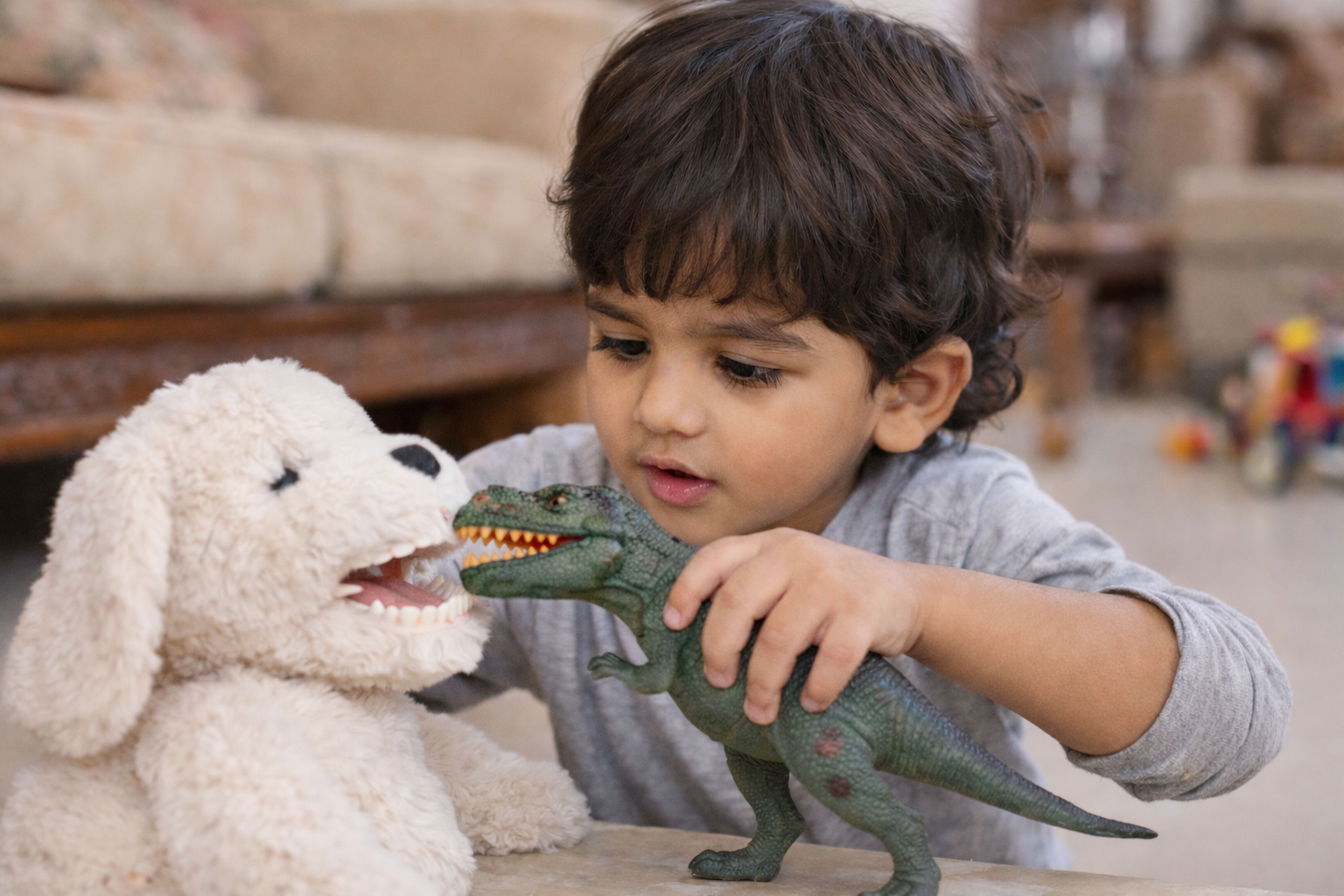
Now, if you’ll excuse me, my kid is using a toy dinosaur to “brush the dog’s teeth,” and I need to go physically restrain myself from intervening.